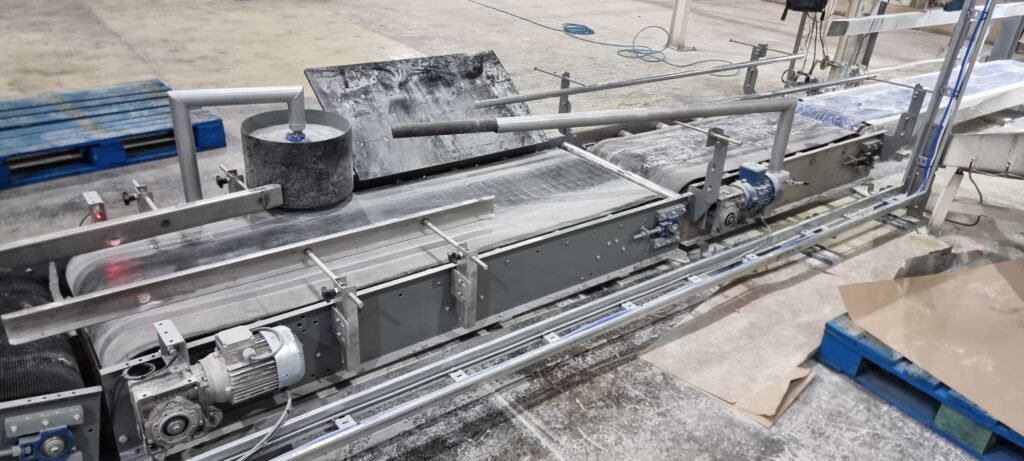
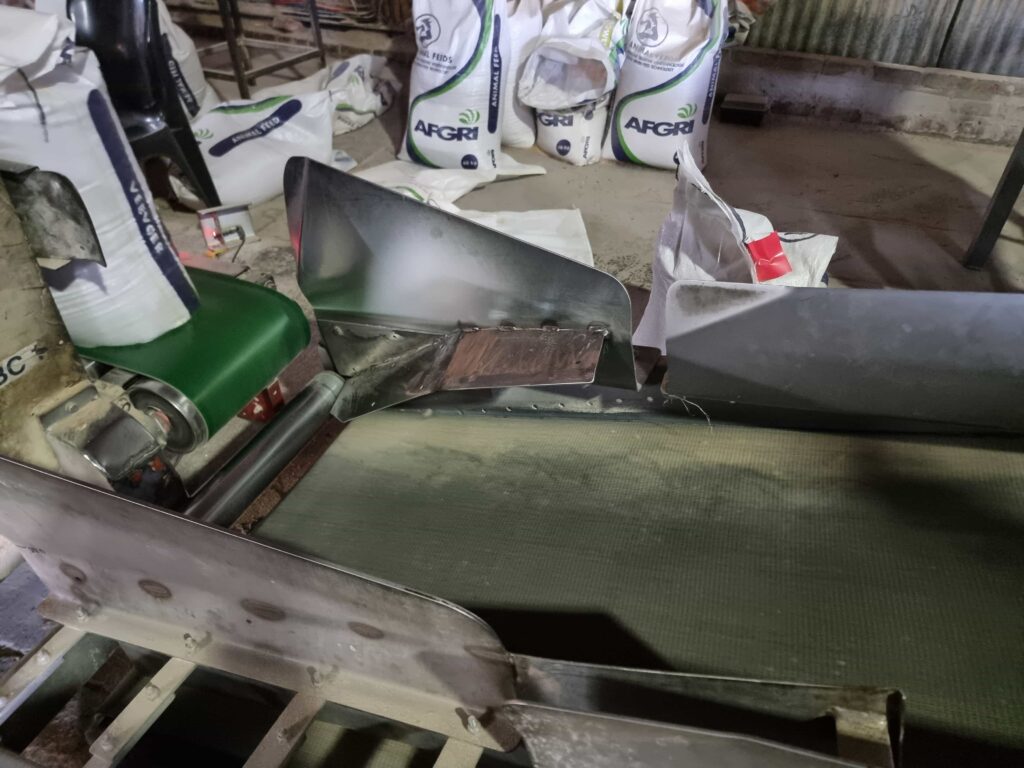
After filling, products have to be laid flat and rotated as needed to ensure proper orientation for palletizing or further processing. When this occurs in line with the product feed, a few considerations are important – such as whether the product’s bottom should lead or trail once flattened, and whether it needs to roll over to achieve the correct flat position for the next stage of handling.
1 - In-line Side-throwover Product Rotator
This process uses a slanted side plate, cross-over bar, and rotation drum stop. In some cases, an additional product rotator is also required. The cross-over bar obliquely straddles the direction of travel, causing the product to first tip sideways onto the slanted plate while the bottom end remains on the conveyor, dragging that end forward. The top of the product then slides down the slanted plate and is squared to the travel direction by the rotating drum stop. The product is now correctly oriented for flattening, though any under rotation may need correction with an additional roll-over bar.
2 - In-line Tip-over Product Rotator
If the bottom of the product can trail the top after being laid flat, a toppling-over system is used. The transporting conveyor is gently slanted upward to provide a minimum lift. The product moves along the conveyor until it abruptly ends, causing the product to arc forward under gravity. It partially lands on a centrally positioned stopper plate, then rolls off, completing a quarter-turn rotation. The degree of rotation can be adjusted by modifying the stopper plate.
3 - Mechanical Product Rotator
When product height, orientation, and position can be precisely controlled, a mechanical gripping rotator is used to grip, rotate, and tilt the product backward. Upon release, the product is correctly squared to the travel direction, with the bottom leading. While this method is more expensive than other rotation and flattening options, it is also the most reliable. Maximum packing rates are somewhat lower compared with alternative systems.