standard Coveyors
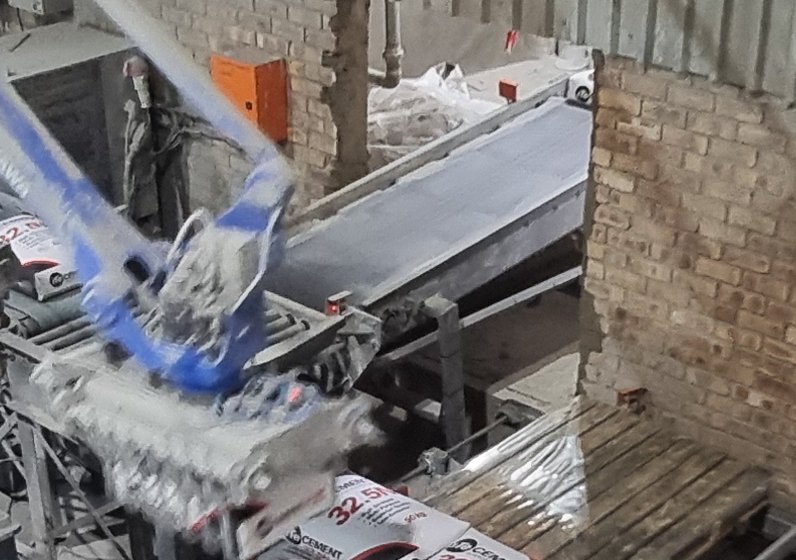
Our standard conveyor systems deliver fast, reliable, and efficient material handling across many industries. Each conveyor uses a motor-driven system, typically with a worm-gear AC motor or a customer-specified drive. We design these units for flexibility and consistent performance in demanding environments. Therefore, you can configure them in many layouts to suit your operational needs. As a result, you benefit from smooth product flow, long-term durability, and minimal downtime.
1 - Infeed Rubber Flat Belt Conveyors (Rough Top or Smooth)
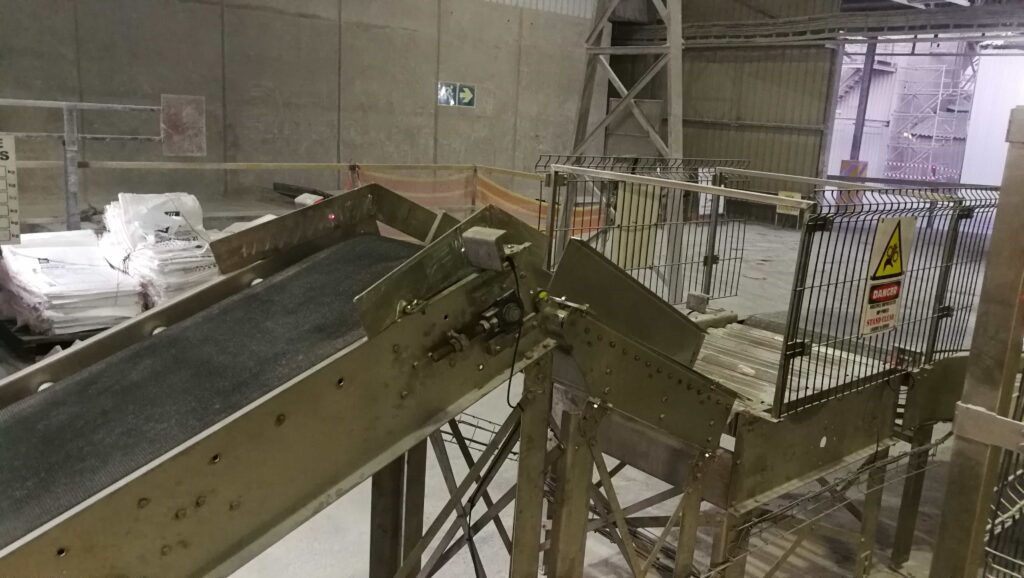
Rubber flat-belt conveyors transport bagged or boxed self-contained products with ease. They usually operate without troughing, keeping the design simple and efficient. Depending on the application, the belt may feature a smooth or textured surface for optimal grip and flow. We determine construction based on function, ensuring the conveyor suits your process needs. To support different requirements, we offer four sub-categories that deliver reliable and tailored performance.
1.1 Flat Belt Conveyor Sections (Up To 5m Conveyors)
This conveyor is our most widely used solution for moving bagged or boxed materials between process points. It runs reliably and requires very little belt-tracking maintenance. Our unique cage roller design includes a natural bevel, so the belt tracks accurately after initial setup. Unlike conventional systems, this design reduces operating belt tension, which extends belt life. Additionally, the open roller prevents material buildup and protects tracking.
The conveyor frame uses two opposing bent plates that run the full length. This structure positions the belt within the frame, providing natural nip protection and maintaining alignment. Adjustable support legs at both ends — and along conveyors longer than two meters — offer ±25 mm height adjustment. Each foot anchors securely for safe operation. For conveying distances over five meters, we recommend multiple conveyors for easier installation, safer maintenance, and improved line flexibility.
1.2 Multiple-Into-One Marshalling Conveyors
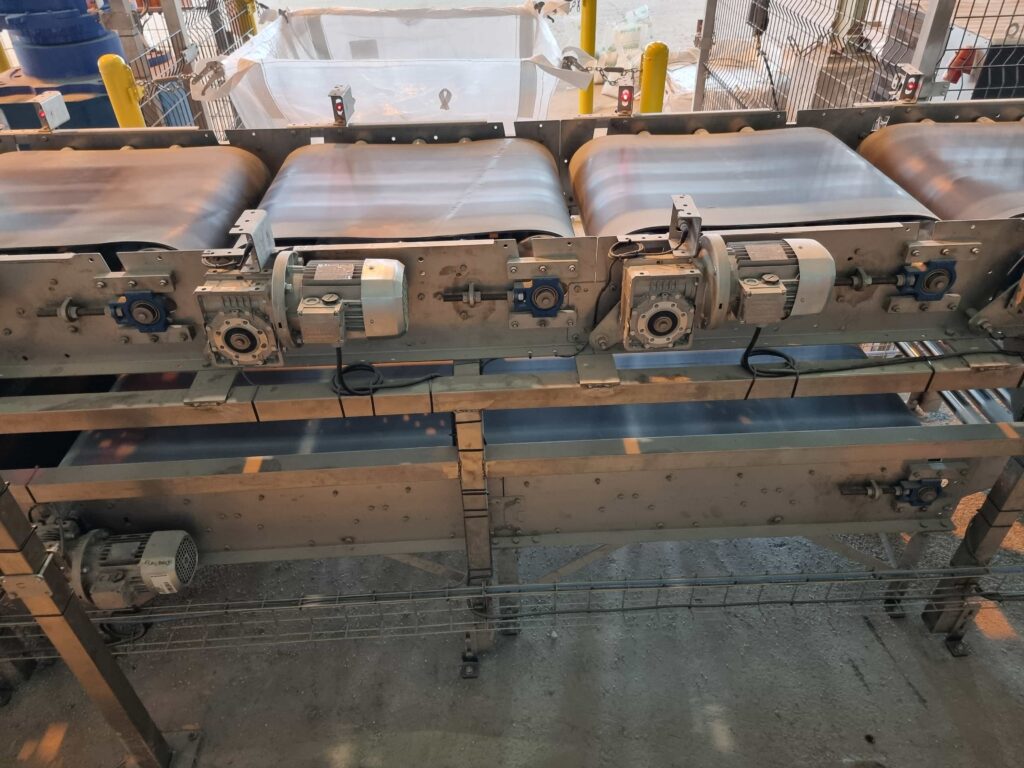
We use a series of short, consecutive flat belt conveyor sections to marshal the infeed line and allow bags to accumulate during brief packing delays. This prevents the need to stop the packers themselves. To simplify installation, we often pre-assemble these sections onto a common subframe. Their modular construction lets us adapt the number of sections to each client’s specific needs, ensuring flexibility and smooth operation across varying packing lines.
1.3 Discard Flat Belt Conveyors
A discard conveyor rarely handles a full load of bags rejected after in-line weighing. Therefore, we design it lighter than the flat belt conveyor sections, reducing construction costs. This approach ensures efficiency while maintaining reliable operation for the limited load it carries.
1.4 Incline and Decline Conveyors
The conveyor’s upper body contains the belt, drive and idler drums, and support rollers, similar to the flat belt conveyor sections. It mainly differs in the type of support legs or structure required. Depending on operational factors, we use either a smooth or grippy belt surface, while extreme angles may require a ribbed belt. Based on load conditions, we may divide the conveyor into multiple sections with separate drives to ensure smooth and reliable operation.
2 - Infeed Modular Belt Conveyors
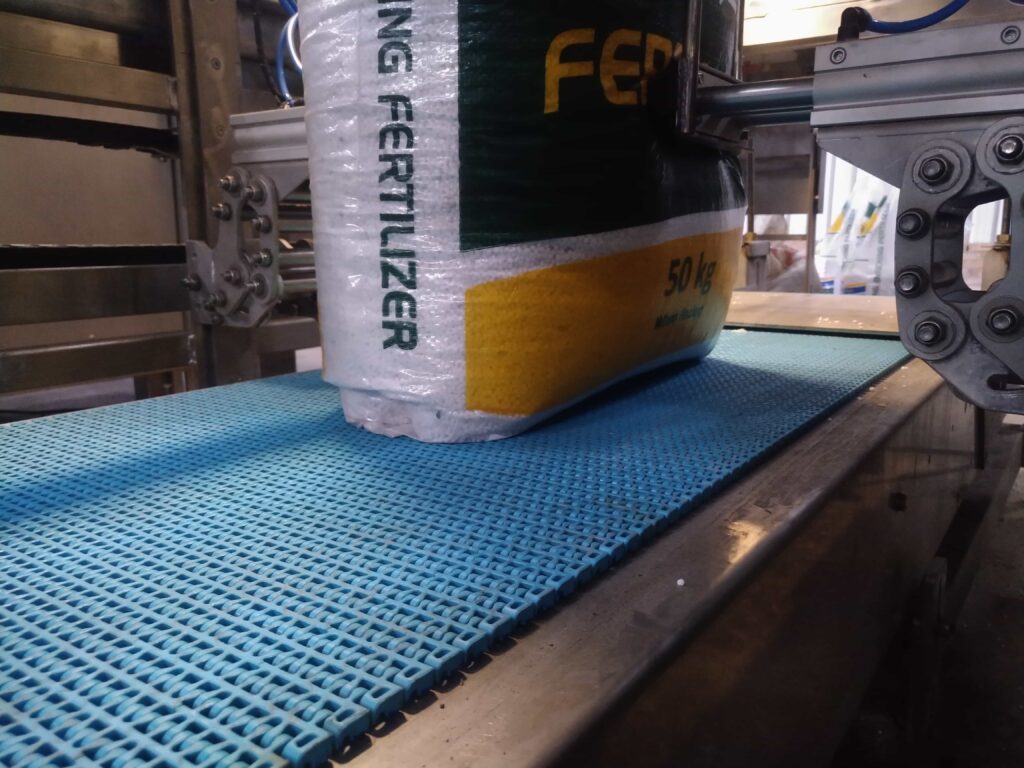
A modular belt conveyor typically features a slider bed connecting two side carrier beams. The remainder of its construction mirrors that of flat belt conveyors. Its main advantage lies in virtually eliminating tracking issues, allowing the belt to follow slightly curved or meandering paths. However, the cost can be higher, especially when specific curvatures are needed. We drive the belt using keyed or square-holed plastic sprockets, spaced evenly across its width, ensuring smooth and reliable movement.
2.1 Straight Modular Belt Conveyors
A modular belt runs between two side guides. Interlocking plastic segments allow slight play between modules and hinge pins, enabling gentle side flexing and smooth path changes. Since the belt segments are moulded, we can manufacture them in a wide range of configurations, finishes, and shapes. We also provide hinge pins in various materials, from stainless steel to wear-resistant plastics. This design works perfectly for conveyors that move frequently or experience slight frame twisting, which could otherwise affect tracking on a solid belt conveyor.
2.2 Curved Side-flex Belt Modular Conveyors
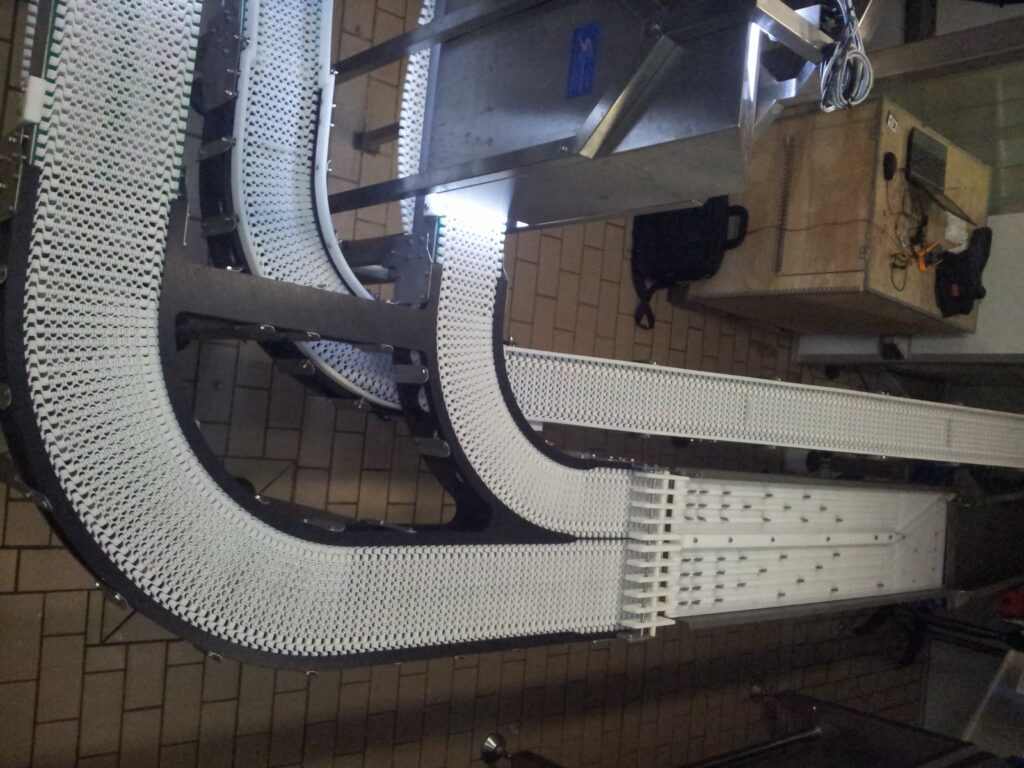
The belt modules feature widened slots around the hinge pins, allowing significant side flex and enabling tight radius curves, typically 1.5 to 2.2 times the belt width. They also accommodate S-shaped and consecutive curved paths. The straight-line load capacity is slightly lower than a standard straight belt without side-flexing capability. When tight radii are required, we machine bends from solid plastic plates, which increases cost. Additionally, we provide a minimum straight section before and after each bend to ensure smooth operation.
2.3 TAB Chain Conveyors
This belt uses modular segments, though it operates differently from the two previously described modular belts. It assembles a central section linked in a chain-like configuration. The belt runs along a narrow slot, while the load platform slides over wear strips. We design these belt segments to operate in both straight and curved pathways. Depending on the client’s application, we may make the main conveyor body simpler or more complex than standard modular or rubber belt conveyors.
2.4 Curved Bend Modular Belt Conveyors
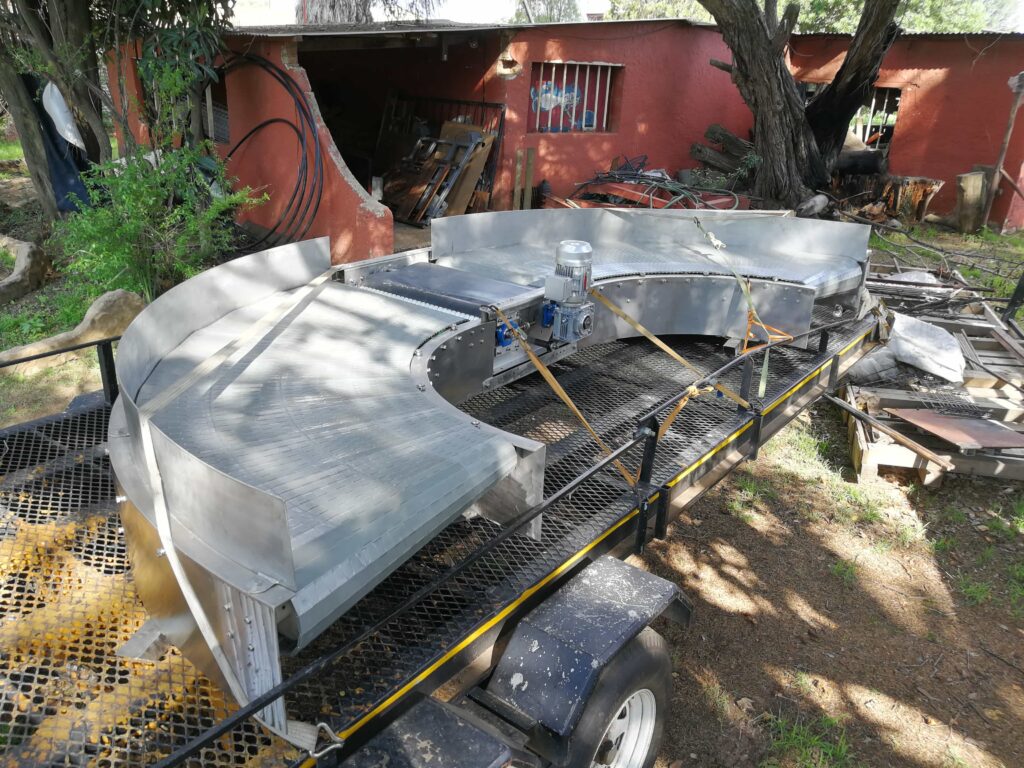
Except for the Curved Side-Flex Belt Modular Conveyor, which includes sharply curved sections, the Curve Bend Modular Conveyor uses tapered belt modules to move products along a defined path and radius. It contains only the curved frame section, without straight belt sections. Depending on load conditions and other factors, we may use a slider-bed or roller-bed construction. Although these conveyors are not inexpensive, they sometimes provide the only solution for reliable long-term operation.
3 - Infeed Diverter Conveyor
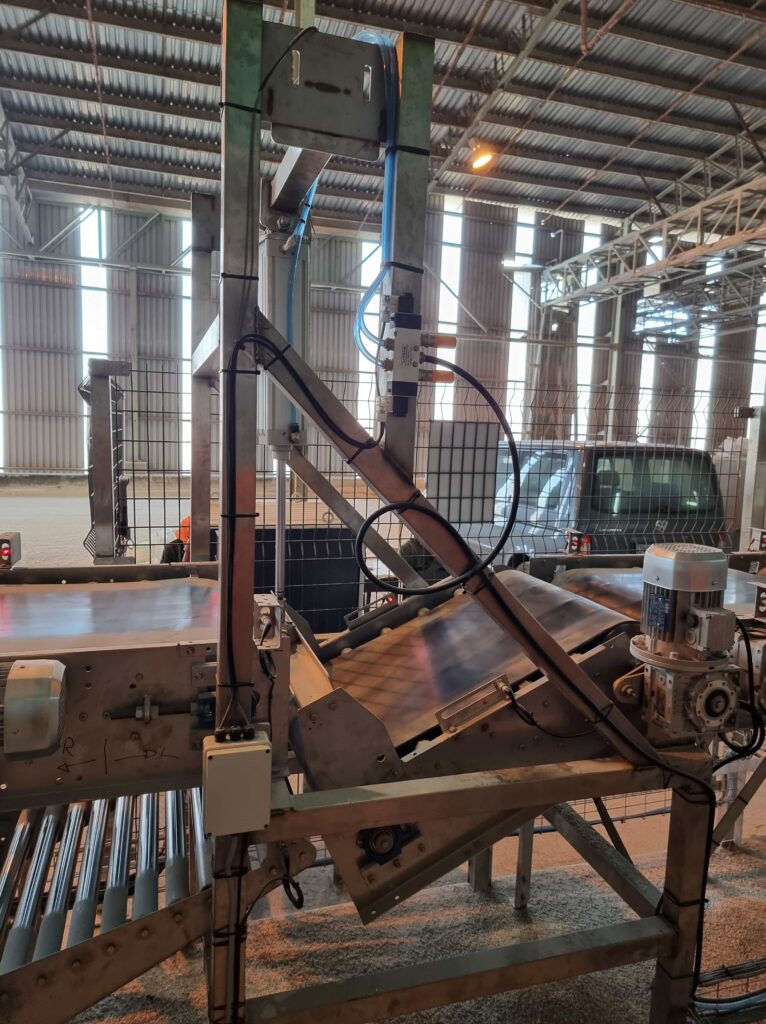
This short, single straight conveyor usually uses a flat rubber belt, though a modular belt can be applied for more complex setups. Its main function is to divert the product path up or down onto a second conveyor. We typically use pneumatic actuation for simplicity and lower cost, but electromechanical diversion is also possible. The conveyor handles diversion rates of up to 2,400 bags per hour.
4 - Light Duty (LD) Chain Conveyors
When transporting empty pallets, the conveyor load is low, allowing us to use a simple, lightweight design. Some pallets cannot travel along two equally spaced parallel chain tracks, so we use a light-duty roller empty pallet conveyor (4.4) to perform the task. The oversized chain has operated for over ten years without needing replacement of chains or sprockets. The conveyor runs over wear strips, which may require occasional replacement under specific conditions. These conveyors operate only in straight sections; we use a rotator section to navigate curves. Chain spacing depends on whether pallets move broad- or narrow-side forward. We also provide additional nip protection when operating inside a safety cell.
4.1 LD Empty Pallet Transfer Chain Conveyors
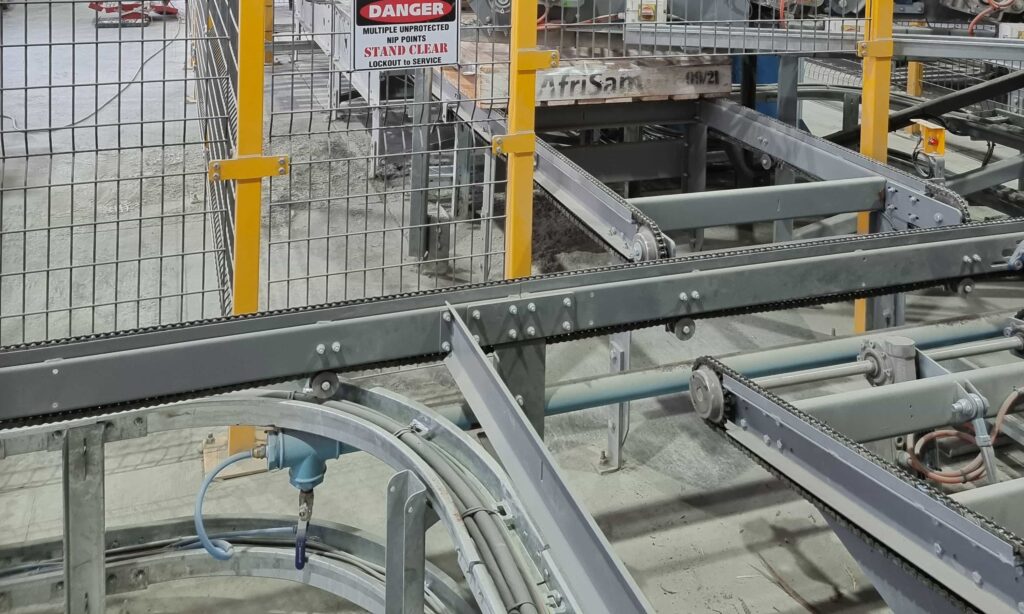
Although these conveyors can cover long distances, operational requirements often call for short, consecutive sections. Each LD transfer conveyor uses a common drive shaft with independently mounted idler sprockets, ensuring smooth and reliable operation
4.2 LD Empty Pallet Transition Popup Chain Conveyors
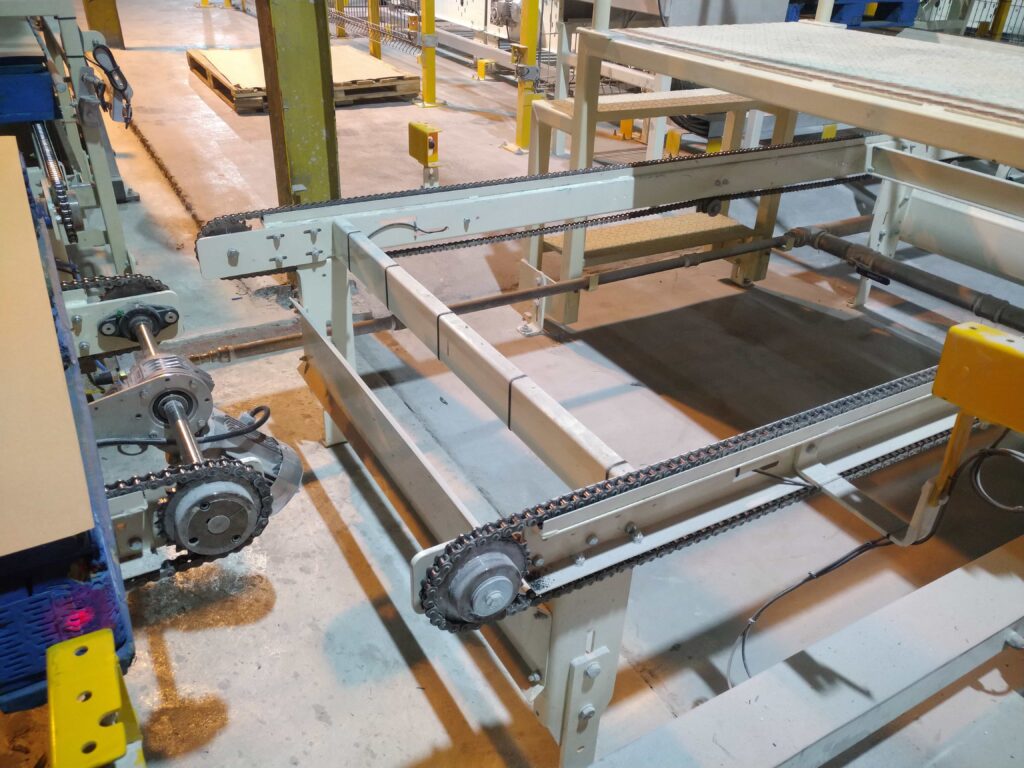
When empty pallets need to move perpendicular to the transfer conveyor, we install a lifting conveyor between the two chains of the transfer line. The conveyor rises to lift the pallet off the first conveyor and transfers it smoothly onto the second conveyor.
4.3 LD Empty Pallet Rotator Chain Conveyors
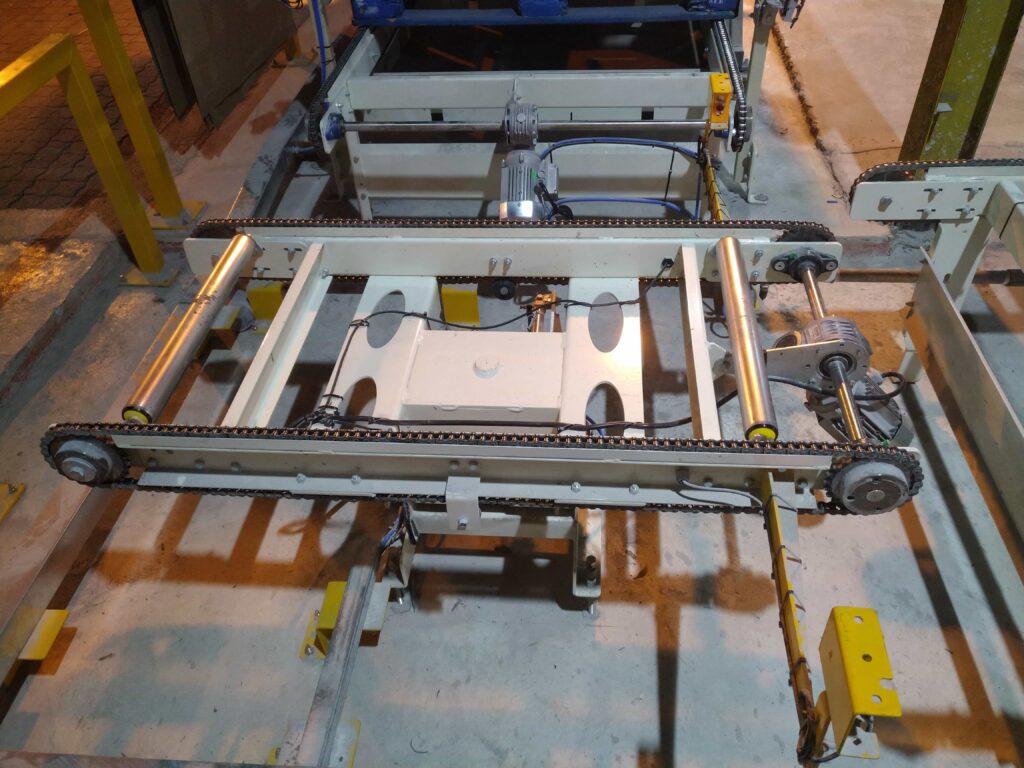
Because empty pallets are light, a lightweight structure can support a short section—slightly longer than the pallet—of the transfer conveyor. The rotation pneumatic actuator is small and slow enough that extra personnel protection is not needed. The empty pallet moves onto the rotator section, pauses while rotation occurs, and then continues off the section once rotation is complete.
4.4 LD Empty Pallet Roller Conveyors
When pallet construction prevents travel along two equally spaced chains with enough position tolerance, we use an LD reduced-diameter roller set conveyor. Depending on operational requirements, we often space the rollers widely to reduce costs while maintaining functionality.
5 - Heavy-Duty (HD) Roller Conveyor
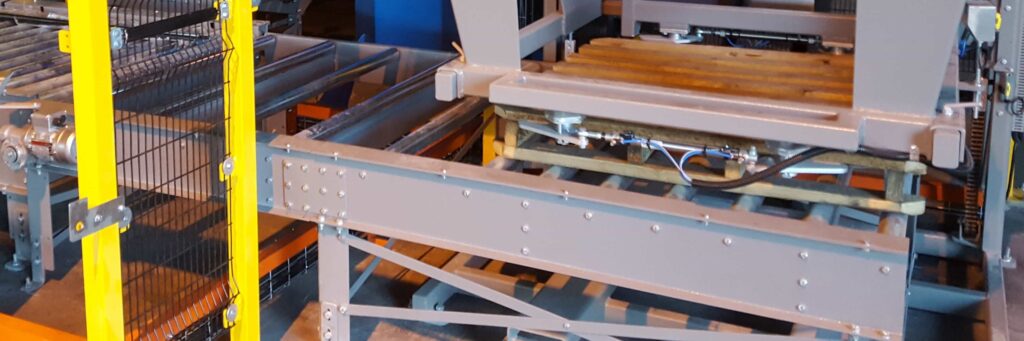
A heavy-duty roller conveyor supports fully packed pallets weighing two to three tons. Pallet orientation ensures the bottom members travel smoothly across consecutive rollers. We determine roller pitch based on pallet load and stiffness. The conveyor has rollers mounted between two heavy side plates, reinforced with cross braces. Leg support length dictates lateral stiffness and may require additional bracing in specific situations. Drive comes from a daisy-chain-connected chain system, with each roller fitted with dual drive sprockets. A safety chain guard protects the roller sprocket ends and prevents dirt ingress. Heavy-duty roller conveyors operate only in straight sections, and an HD rotator handles bends. We offer conveyors for both broad- and narrow-side leading pallet orientations.
5.1 Heavy Duty (HD) Pallet Roller Conveyors (2 Ton and more)
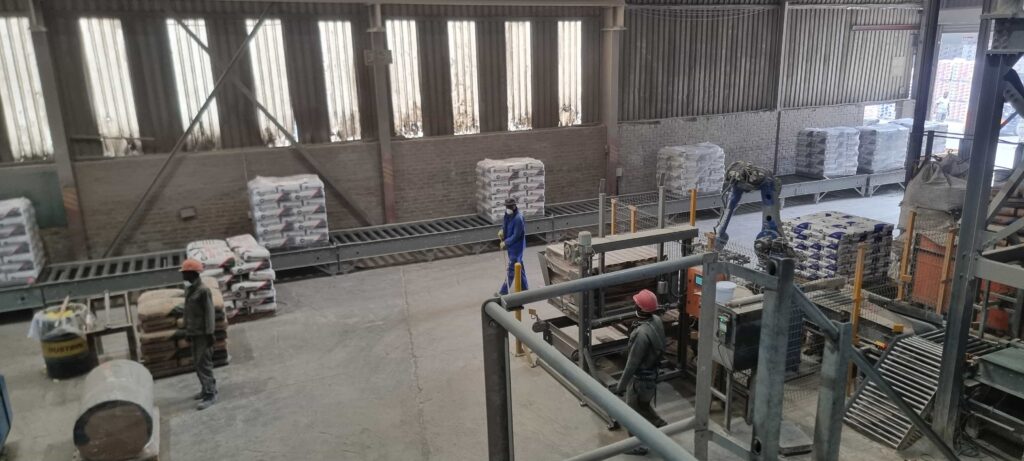
Our heavy-duty pallet handling roller conveyors are robust, with large-diameter steel rollers and reinforced frames to carry heavy loads. We design them for modular, customizable configurations that integrate seamlessly into existing systems. We carefully control conveyance speed to prevent damage and maintain safety. A positive chain drive system enhances reliability and ensures consistent performance. Full pallet movement often requires highly marshalled motions. To reduce costs, we optimize the lengths of these marshalled sections. Under certain conditions, building a long HD outfeed line saves on space and forklift travel. Combing the long line with HD Pallet Rotator Conveyors (5.2.) makes for an extremely versatile product offering.
5.2 HD Pallet Rotator Conveyors (0° to 90° and 180°, or any angle in-between)
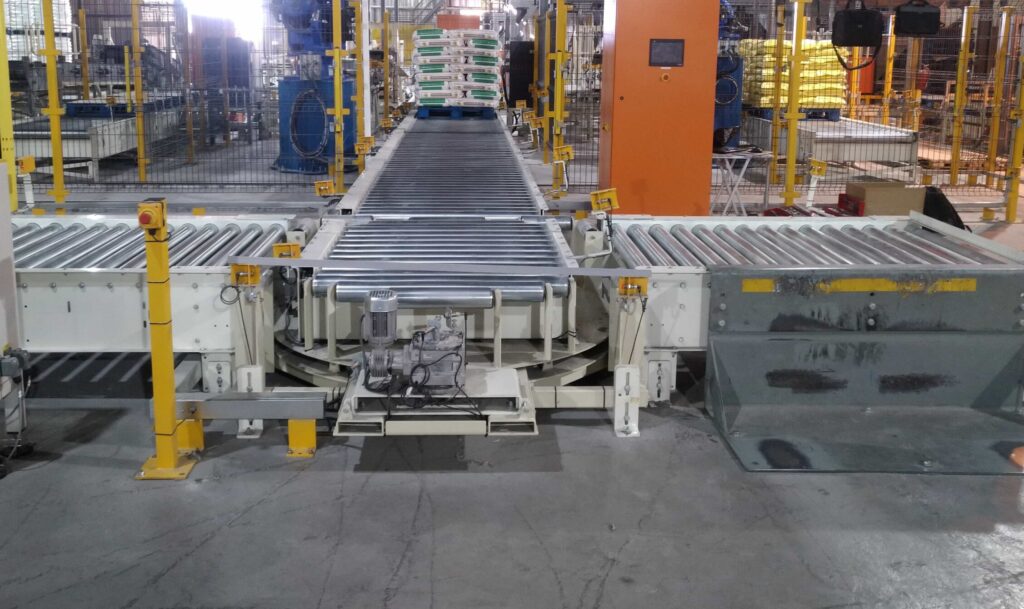
Extreme point loads between rollers and fully loaded pallet decks make pallets reluctant to follow curved paths. When a travel direction change is required, we use an HD Pallet Rotator for an efficient solution. We mount a standard HD roller conveyor section on a heavy-duty rotating platform. Considering pallet stiffness and the arced motion of rotating edges, we sometimes require special lead-in and lead-out roller configurations. Our HD Pallet Rotator Conveyors use mechanical stops and a sensor-interlocked three-phase motor to provide robust, repeatable motion. A strong chain and geared AC motor assembly drives rotation reliably.
5.3 HD Pallet Transfer Carts and Conveyor
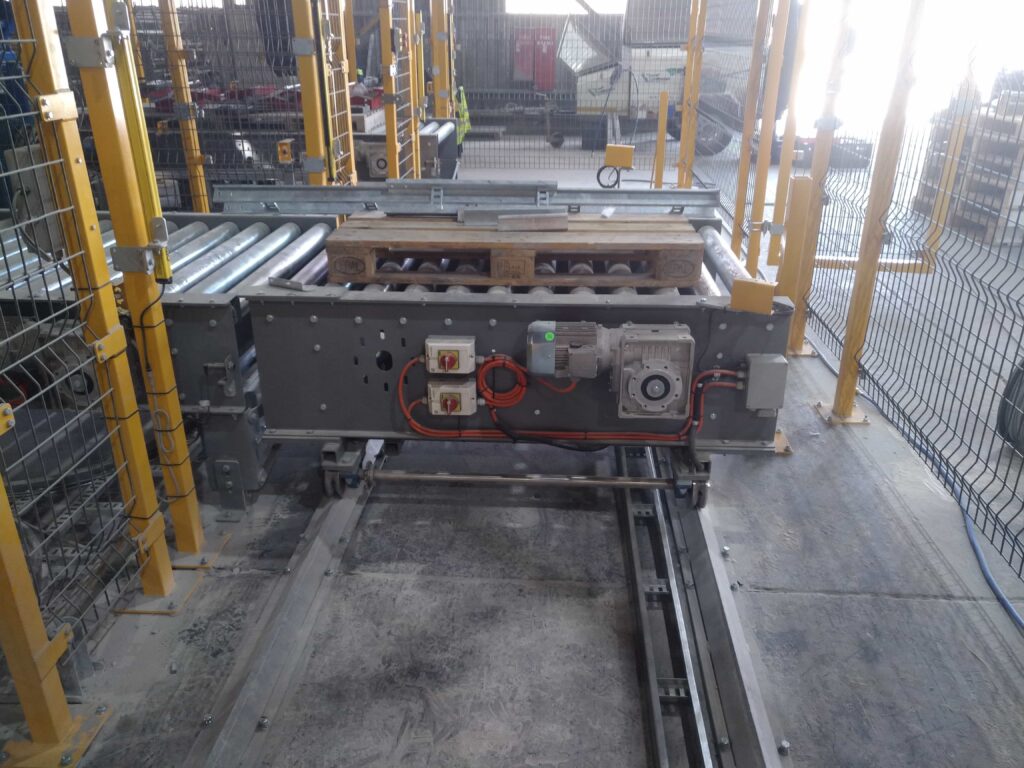
When operators need to switch pallets and combine outputs from multiple full-pallet packing lines onto a single take-off line, we use a Transfer/Travel/Bogie Cart. We mount a standard HD roller conveyor section on a heavy-duty, wheel-driven cart frame that runs along fixed rails. Depending on accessibility, travel length, and operational requirements, we supply power to the pallet transfer cart via an overhead cable system, a floor-mounted energy chain, or a floor-mounted chain drive.
5.4 HD Pallet Conveyors with Built-In LD Popup
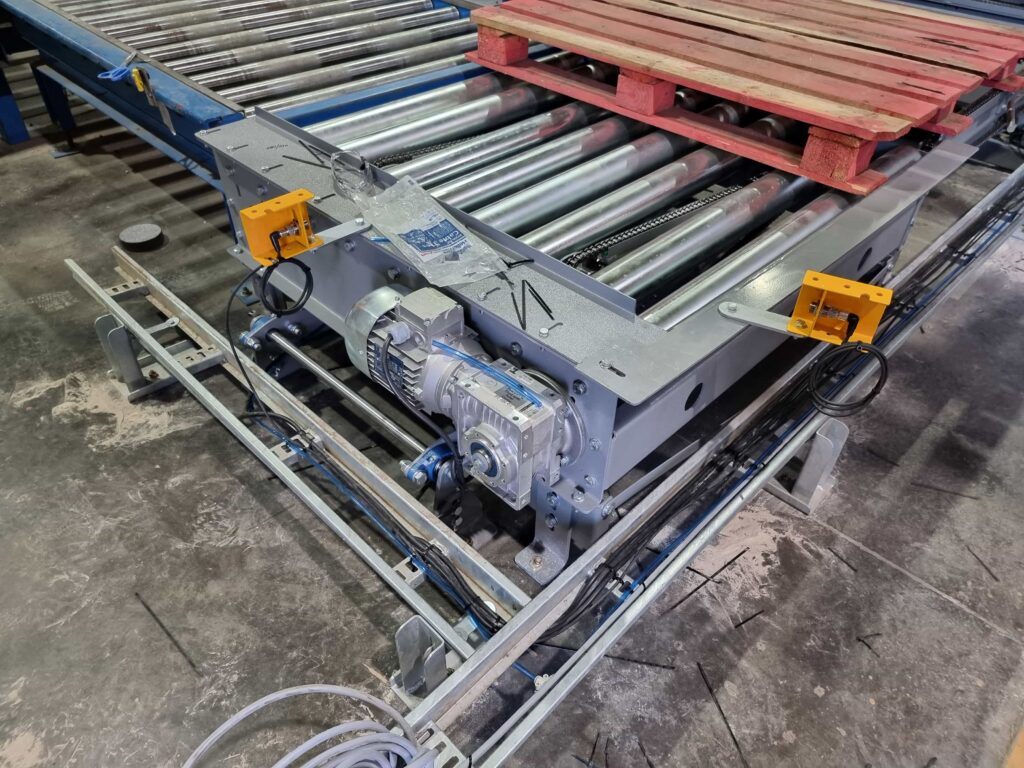
In some installations, operators must feed empty pallets at right angles to the full pallet exit direction. In these cases, we combine a standard LD pop-up conveyor with a standard HD roller conveyor to create an effective solution.
5.5 HD Pallet Conveyors with Full Pallet Aligners
When lateral pallet alignment is critical—such as before in-line automatic stretch wrappers and hooders—we attach a pneumatically actuated sideways pushing mechanism to a standard HD roller conveyor. We provide additional roller length to ensure the required travel distance while maintaining minimum clearances along the path.
6 - Heavy Duty (HD) Chain Pallet Conveyor
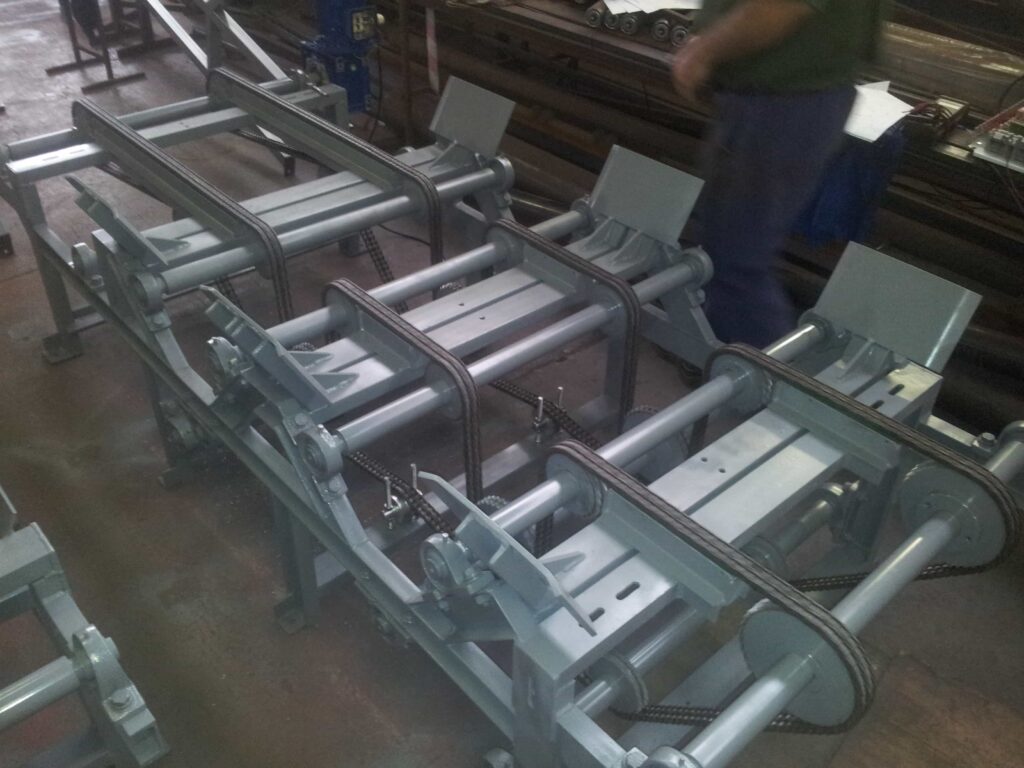
When the pallet bottom deck boards block movement across rollers, we install two heavy-duty plastic or metal chains running over guide strips. We design the chain structure according to the load weight. Standard length options match those of HD roller pallet conveyors. For longer travel distances, we use agricultural chain options.
7 - Client Specific Conveyors (Built to Customer Specification)
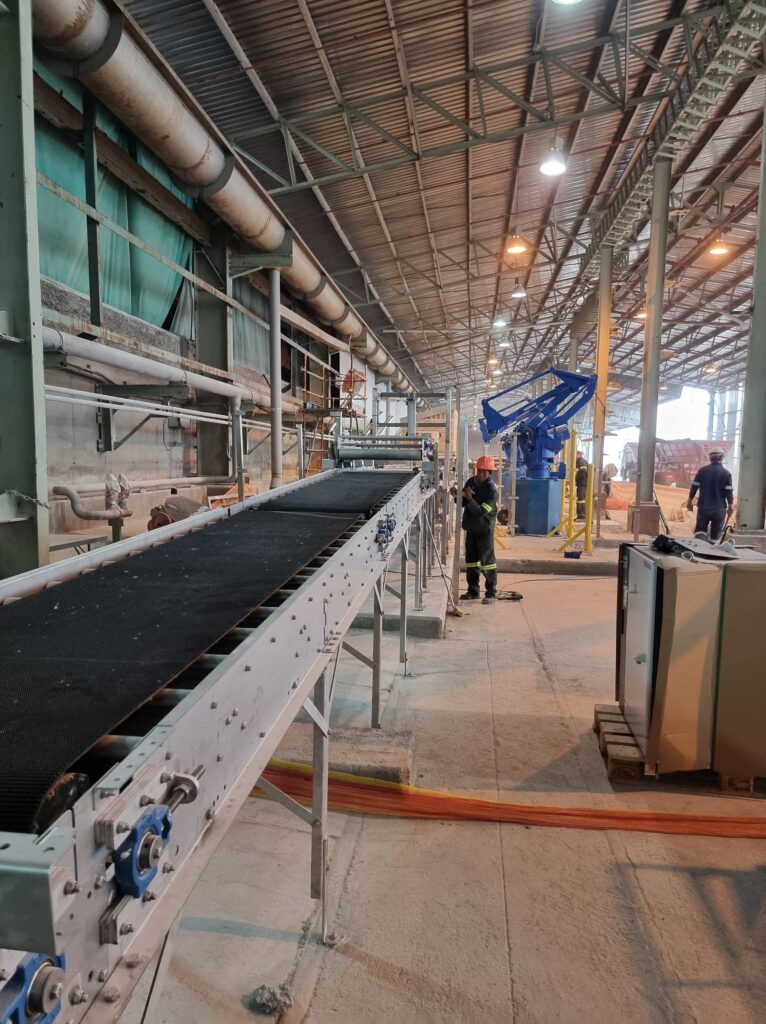
Our in-house technical and engineering teams design bespoke, client-specified systems and conveyors. We develop solutions for the agro-processing industry, covering primary product handling in the agricultural, fishing, and forestry sectors.
8 - Modified Existing Client Conveyors
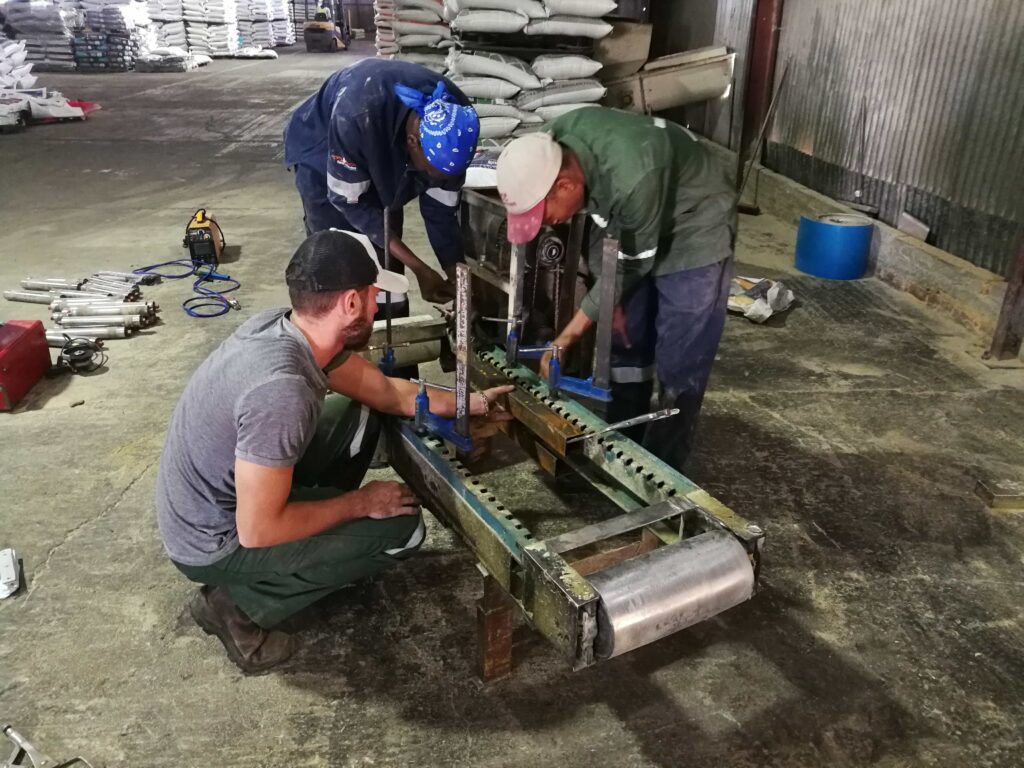
As a rule of thumb, investing in new equipment is often more cost-effective when considering manpower, modification effort, and the risk of reduced functionality. Occasionally, we modify or rebuild a client’s existing conveyor for repurposing. Our focus remains on exceeding client expectations, and no viable option is ever off the table.