commercial products
Standard Conveyors
ChatGPT said:
Our standard conveyors offer a fast, reliable, and efficient solution for material handling across a wide range of applications. Each unit is motor-driven, typically using a worm gear AC motor or a customer-specified drive system. Designed for versatility, these conveyors can be configured in numerous layouts and functions to suit various operational needs, ensuring smooth and consistent performance in demanding environments.
Gravity Decline Roller Conveyors
Unlike standard conveyors, this type relies on gravity for motion. When height and conditions allow, gravity simplifies conveyor operation. It typically consists of two bearer beams with idler rollers between them. Product type and desired speed determine the decline angle, which is confirmed experimentally. If product characteristics vary too much (e.g., sacks vs. boxes), a standard decline conveyor is recommended.
Bag Flattener & Shaker Conveyors
Products are often unevenly distributed and must be reshaped for palletizing. This is done using a shaker conveyor or flattener. A shaker redistributes product from tail to front/vice versa, & a flattener compresses it between two surfaces for uniform shape. The product’s resistance determines whether a roller-top or driven top-belt design is used. Flatteners move product only from front to tail, making both systems valuable for different redistribution needs.
Abrupt Infeed Direction Changers
At times, products need to change direction abruptly during handling. When chutes or gravity declines are unsuitable, a mechanical kick-off provides an effective solution. It is a more cost-efficient option than a driven modular bend and can also be used to control product orientation – either maintaining bottom out first or changing it as needed by adding a cross-bar for precise guidance and positioning.
in-line Infeed Rotation Changers
After filling, products have to be laid flat and rotated as needed to ensure proper orientation for palletizing or further processing. When this occurs in line with the product feed, a few considerations are important – such as whether the product’s bottom should lead or trail once flattened, and whether it needs to roll over to achieve the correct flat position for the next stage of handling.
Pickup's
The pickup is the central point of the packing line, where all preceding equipment ensures the product arrives at the right time, position, and orientation. Its placement relative to the robot and pallets is critical. Based on operational needs & packing layout pickups are built for reliable and repeatable performance, with design and actuation via internally or externally mounted worm-geared motors.
Pallet Dispenser & Stacker
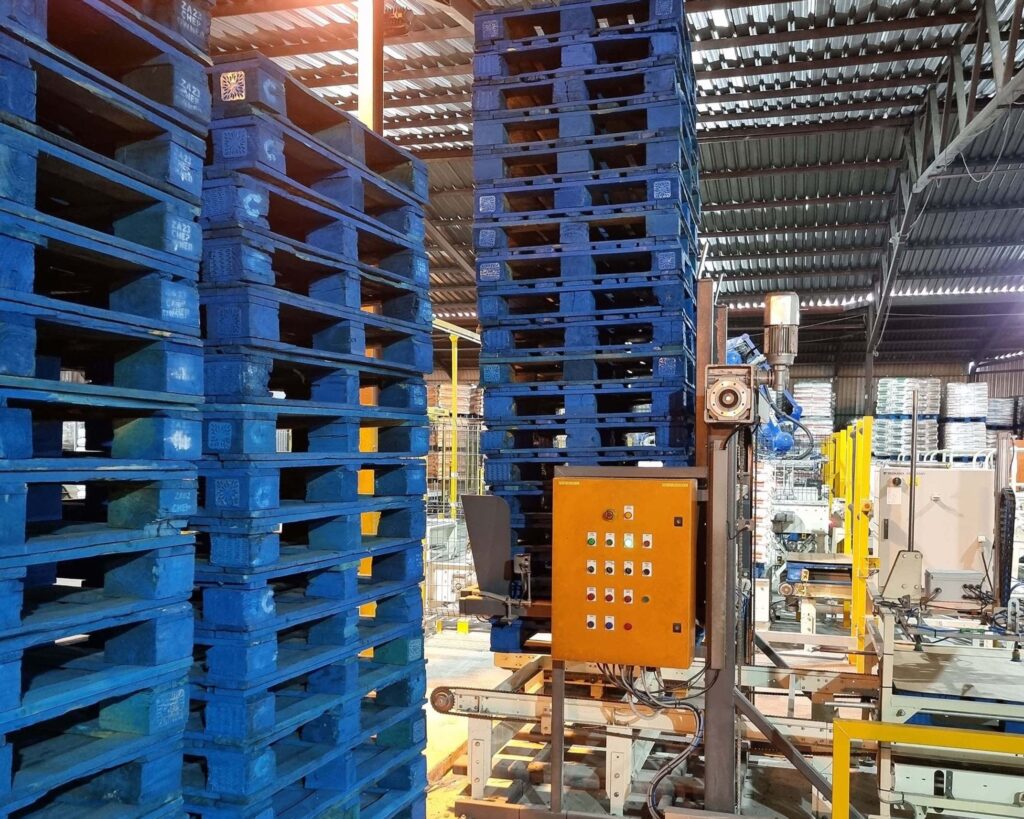
Our pallet dispensers are among the simplest and most durable available, proven reliable over time. Three vertical positions are controlled by dustproof inductive sensors, triggered by independently adjustable cams. This allows easy adjustment for any pallet height, accommodating up to 20 mm variation on a 160 mm pallet. Additional cams can be added to further extend the adjustment range, ensuring consistent and trouble-free operation.
Slip Sheet Applicator
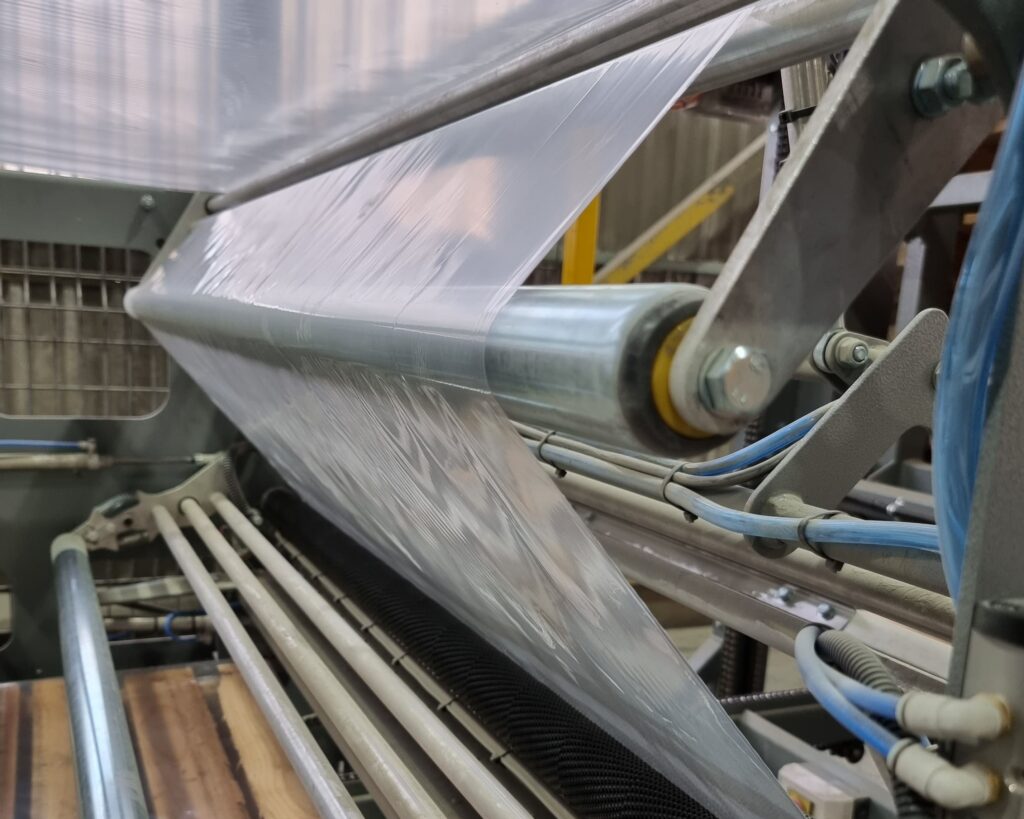
Some products, such as cement, are sensitive to moisture and require a plastic sheet (often cost-effective in bulk rolls). Our slip sheet applicator measures a specific length from the roll, feeds a pallet in underneath and drops the sheet in place, securing the four corners with heat. In drafty areas, protection against the wind is needed to prevent sheets lifting off the pallets before packing. The system can handle 60–70 pallets p/h.
Bottom Sheet Placer
A bottom sheet is placed on the pallet to protect the load from sliding, damage, and shock from handling or the pallet itself. Our bottom sheet placer picks up a pre-cut sheet, moves it across the pallet, and positions it accurately, handling up to 120 sheets p/h. Sheet permeability is critical: too porous or too sealed sheets can cause multiple picks. We reduce this by slowing down movement and adding a gentle shaking motion during the pick.
Robot And Robot Base
We standardise on the Yaskawa robot range, though other robots are occasionally used. Yaskawa robots are valued for their speed, flexibility, and efficiency in dynamic tasks, while competitors are noted for precision. Yaskawa excels in complex applications. Their product range includes AC drives and motion control, which integrate seamlessly with their robotic solutions.
Grippers (End-Of-Arm Technology)
Alongside the pickup, grippers are critical to a packing cell’s performance. Incorrect selection can compromise the system. Our in-house designed grippers are extensively tested for reliable, robust operation, with sensors kept to a minimum to reduce false alarms. Built for each specific task, they run consistently unless there is a major mechanical failure.
Pallet Wrapping
There are many pallet wrapping and hooding options available today. We maintain a comprehensive network of suppliers capable of meeting virtually every industry requirement. Client-specified equipment can also be directly imported, installed, and fully commissioned as part of our packing lines, ensuring seamless integration and reliable long-term operation.
Weighing Solutions
We offer inline check weighers and inline pallet weighing stations for a wide range of applications. Free-standing scales are standard off-shelf items. Our in-house developed check weigher is provided in collaboration with a scale design specialist to ensure optimal performance. The readout data can be fully integrated into your own data collection system.
Automatic Placing & Closing
The manufacturing industry relies on imported labour and expertise. Our in-house bag placing machine retrofits existing manual packing lines. The 4th-generation fully automated system handles 5–80 kg maize bags and allows manual packing during repairs. It consists of two main sub-systems working together to ensure reliable operation, even in remote locations.
Trapdoor Marshaller
A common issue for in-line manual packers is filled valve bags dropping off onto the take-away conveyor. We developed a two-stage trapdoor bag marshalling system, interlocked with the packer release, that aligns bags for the line. The modular design allows the number of spouts to be customised per client, and the weighing cradle and push-off system are client-specific.
Safety and Electrical Controls
Packing cell offerings include all the shown line items. Additionally provided is an electrical line item covering all wiring, trunking, electrical control boxes and panel building, isolator switches, the PLC and HMI, with the interlocked safety system listed separately. This cost component is significant.
Installation & Commissioning
We are experienced installers and integrators, providing reliable and accurate estimates. Installation and commissioning takes ± 10 days per packing cell or robot and is offered at a fixed cost. This service is also included as a combined line item on our quotes, ensuring full transparency for clients.
Commercial Services
We offer comprehensive Commercial Services for industrial packing lines, combining expertise in design, installation, maintenance, and plant servicing. Our experienced team ensures reliable and efficient operations, providing technical support, spares supply, and equipment upkeep.
Built for Performance
why choose our products?
Built for demanding commercial environments, Mechaneer’s automation systems combine cutting-edge engineering with proven reliability. Our range of packaging products is designed to meet the unique needs of high-volume production while ensuring smooth, efficient, and cost-effective operations.
- 20+ Years trusted expertise
- Custom automation systems
- cost-effective Solutions
- commercial-grade reliability
ready for a system?
get in touch with us today
Choosing the right packaging system shouldn’t be complicated — and with Mechaneer, it isn’t. Our engineers and technicians work closely with you to design, build, and install automation systems that meet your exact production goals.
Let’s start the conversation.
- Contact: Wynand / Jeroen
- number: 0836907869 / 0824589785
- Adr: 213 Eureka st, Pomona, Kempton Park