Eendag Meule Case Study
During lockdown in 2020, we placed a bold Multi-Million Rand bet to automate a South African maize giant. Eendag Meule needed a reliable, Minimal Labour, fully local turnkey solution—and four years later, the machines are still running 24/7, proving the power of resilient, homegrown engineering.
1 - Executive Write-up
The multi-million Bet: How We Automated a Maize Giant During Lockdown
In 2020, while the world stopped, we started designing.
The Context:
Eendag Meule (Bothaville) processes 500,000 tons of maize annually. They are the “Maize Capital” heavyweights. But they had a vulnerability: 4 manual packing lines that were susceptible to the annual labour issues that plague South African production.
The Challenge (The Looming Slide):
The owner, Mr. Martin van Deventer, needed a “Turnkey” solution. He needed one neck to wring—a single supplier accountable for everything from the bag placer to the wrapped pallet.
Initially, Mechaneer wasn’t even on the list. Why? Because the market believed only European imports could handle a “Full Turnkey” automation project of this scale.
The “Walter Röhrl” Moment:
During a meeting to buy back old equipment, we realized the client was about to buy imported tech that required overseas specialists to maintain.
We told him: “We are finishing a design for a bag placer that handles 5kg to 80kg on a single platform. Something no Euro-machine can do.”
We didn’t have the machine built yet. We had the researched concept and the “schooling” from past failures. We stuck our necks out and asked him to act on faith.
Ten days later, the deposit was in the bank. We were on the chopping block if we failed.
The Solution (The Intervention):
We developed what we call “Non-Eurocentric” Tech.
- Robust: Designed for the harsh realities of the SA grid and environment.
- Maintainable: “Almost analogue” logic that local technicians can service in-house without a plane ticket from Germany.
- Versatile: A single embodiment machine that handles their entire product range (5kg–80kg).
- World First: The only machine capable of converting back to manual packing, should the need arrise while waiting for parts out in Africa
The Results (The Finish Line):
Four years later, the #2 models are still running 24/7.
- Strike-Proof: Labour strikes no longer cripple the facility.
- Efficiency: Stock moves from the mill directly onto trucks, reducing massive storage overheads.
- The Verdict: Mr. van Deventer’s feedback? “These are some of the best machines I have ever seen.”
The Lesson:
In 2016, we learned a painful lesson at a lime mine about not being prepared for “unspoken” regulations. It cost us dearly. We used that pain to ensure that when we walked into Eendag Meule, we weren’t just bringing a machine—we were bringing a solution that was ready for the “cricket match” even if we were told it was “baseball”.
Simple. Robust. Reliable. That’s Mechaneer’d.
2 - Detailed write-up
Case Study: Strategic Automation of Multi-Format Packing Lines
Client: Eendag Meule (Pty) Ltd
Location: Bothaville, Free State, RSA
Project Dates: March 2020 (Design & Manufacture) – Palletizing Line March 2021 (Commissioning) – Autoloaders (November 2021: Line 3, March 2022: Line 2 & June 2022: Line 4)
Industry: Industrial Maize Milling & Extrusion
- Project Context & Baseline
Eendag Meule Is a high-capacity milling facility processing 500,000 tons of maize per annum. Prior to this intervention, the facility operated a combination of two semi-automated lines and four manual packing lines. Despite high efficiency in milling, the end-of-line palletizing remained a critical bottleneck, vulnerable to external labour disruptions and manual handling limitations.
- Technical Challenge (The Strategic Risk)
- Capacity Goal: Doubling milling capacity necessitated a consistent, year-round palletizing rate of up to 90 tons per hour.
- Operational Risk: The volatility of regional labour strikes posed a risk of total plant shutdown during peak demand.
- Vendor Requirements: The client required a single-point-of-contact (Turnkey) for accountability across the entire packing floor, from bag-placing to wrapped pallets.
- Technical Constraint: Existing “Eurocentric” machines were dismissed due to the difficulty of sourcing specialized overseas technicians and parts during the global lockdown, alongside a requirement to handle a diverse range of 5kg to 80kg bags on a single platform.
- The Mechaneer Solution (Design & Implementation)
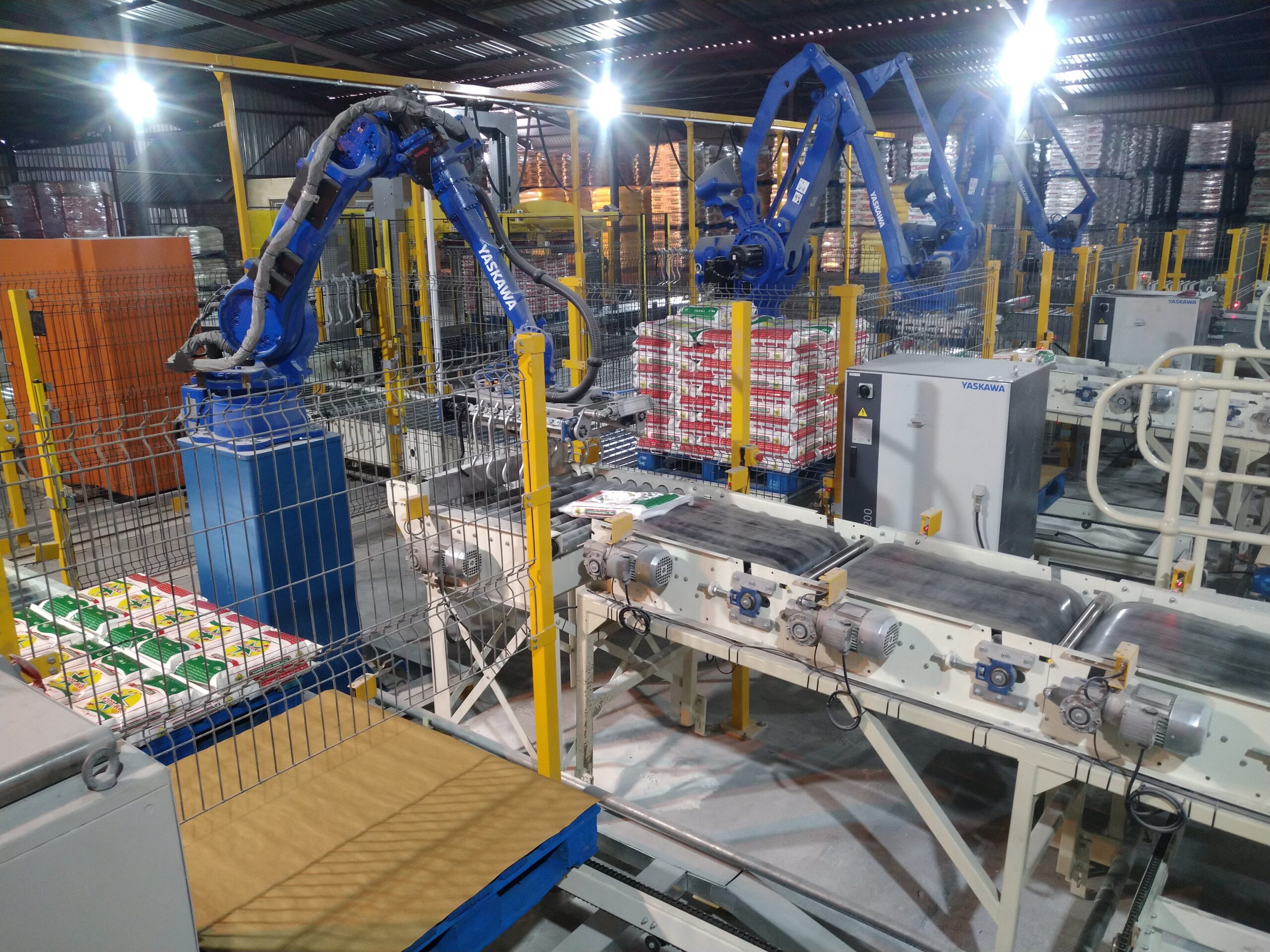
Building on a successful 2018 palletizer installation, Mechaneer leveraged the 2020 lockdown to develop a proprietary, “Non-Eurocentric” Automatic Bag Placer.
- Design Criteria: The system was engineered to be “analogue-first,” utilizing robust components that can be serviced by local site technicians without proprietary diagnostic software or imported expertise.
- Universal Handlers: A unique mechanical embodiment was developed to handle the full range of product weights (5kg to 80kg) within one machine footprint.
- Implementation: The final turnkey installation integrated three fully automated bag placing machines and four automated palletizing lines, successfully maximizing utilization of the existing floor space without requiring structural expansion.
- Operational Results & Archive Data
- Production Buffer: The transition from high-volume manual storage to direct-to-truck palletizing significantly reduced onsite inventory overhead.
- Uptime: The #2 model installations (since evolved to #4 CNC standards) have maintained 24/7 operation for 4+ years with Minimal training requirements for floor staff.
- Resilience: The facility successfully remained operational through subsequent labour strikes, validating the strategic move to automation.
- Institutional Lessons Learned (For Internal Records)
- The “Baseball vs. Cricket” Rule: Reconfirming the necessity of pre-project audits for varying regulatory standards (e.g., Factory vs. Mining safety protocols).
- The Serviceability Loop: Phone-based technical support is only effective when the machine logic is simplified for the end-user. The success of this project confirms the value of the “Mechaneer’d” analogue-first design principle.
3 - Technical Specs
This section details the primary mechanical and sensor components used across both the palletizing and bag placer lines, providing a record for future engineering reference.
1.Supplied Motor & Gearbox Specifications (Main Lines)
The following Bonfiglioli VF and W series right-angle worm gearboxes were used, paired with 3-phase, 380 VAC, 50 Hz motors common in South Africa.
Qty | Motor KW | Gearbox | Mount | Ratio | Motor Frame |
10 | 0.18 | VF49 | P 1 | 1:70 | P63-B14 |
4 | 0.18 | VF49 | P 1 | 1:70 | P63-B14 |
2 | 0.37 | VF49 | F 1 Flange | 1:24 | P71-B14 |
1 | 0.37 | VF49 | F 1 Flange | 1:24 | P71-B14 |
12 | 0.37 | VF49 | Torque Arm | 1:60 | P71-B14 |
6 | 0.55 | W63 | Torque Arm | 1:64 | P80-B14 |
6 | 0.55 | W63 | Torque Arm | 1:64 | P80-B14 |
3 | 0.75 | W63 | Torque Arm | 1:45 | P80-B14 |
16 | 0.75 | W63 | UFC 1 Flange | 1:45 | P80-B14 |
1 | 0.75 | W75 | UF 2 Flange | 1:50 | P80-B14 |
1 | 0.18 | VF44/W86 | UFC Flange | 1:400 | P63-B14 |
2.Control & Sensor Technology (Bag Placer Lines)
The bag placer lines were mechanically designed with a focus on robust, “analogue-first” reliability using standard industrial components to facilitate easy local maintenance.
Component Type | Application | Key Features |
Pneumatics | Bag handling, gripping, and positioning | Primarily double-acting cylinders for precise linear motion control. Utilizes standard 5-way, 2-position valves and FRL (Filter/Regulator/Water trap) units for reliable air preparation. |
Motors | Conveyors, linear motion on bag placers | Standard 3-phase, 380 VAC motors operating at 50 Hz, designed for robustness and ease of local servicing. |
Laser Distance Sensors | Precise bag opener positioning & orientation feedback | Uses time-of-flight (ToF) principles to provide high-accuracy, non-contact measurements in a dusty environment. |
Position Sensors | Cylinder stroke verification & safety interlocks | Cylinder position reed switches and dustproof inductive sensors used for reliable feedback on mechanical position, essential for system synchronization. |
PLC & HMI | Process Control and User Interface | Omron (or Delta) Control PLC, Safety PLC and HMI’s are used to implement programming logic within the conveyor and related equipment interlocked control groups, with essential operator input via the HMI such as programme selection and bag sizing detail changes to automate setup and running. |
Eendag Meule - simply the best