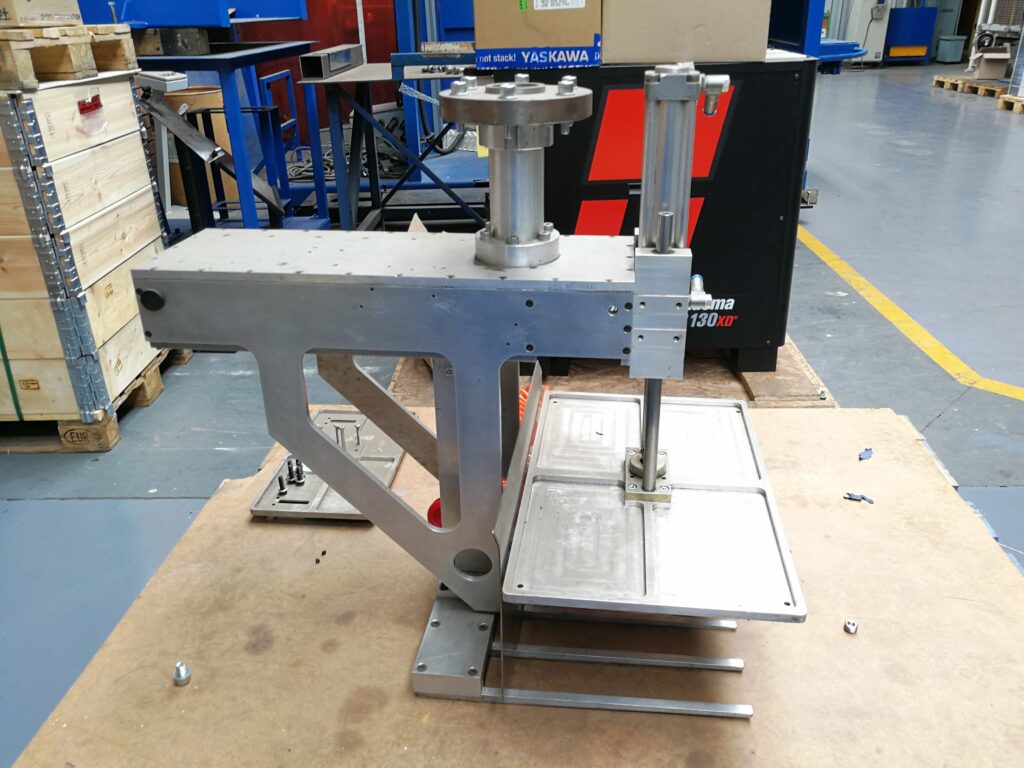
Grippers (End-Of-Arm Technology)
Alongside the pickup, grippers are critical to a packing cell’s performance. Incorrect selection can compromise the system. Our in-house designed grippers are extensively tested for reliable, robust operation, with sensors kept to a minimum to reduce false alarms. Built for each specific task, they run consistently unless there is a major mechanical failure.
1 - Narrow Profile Gripper (NPG)
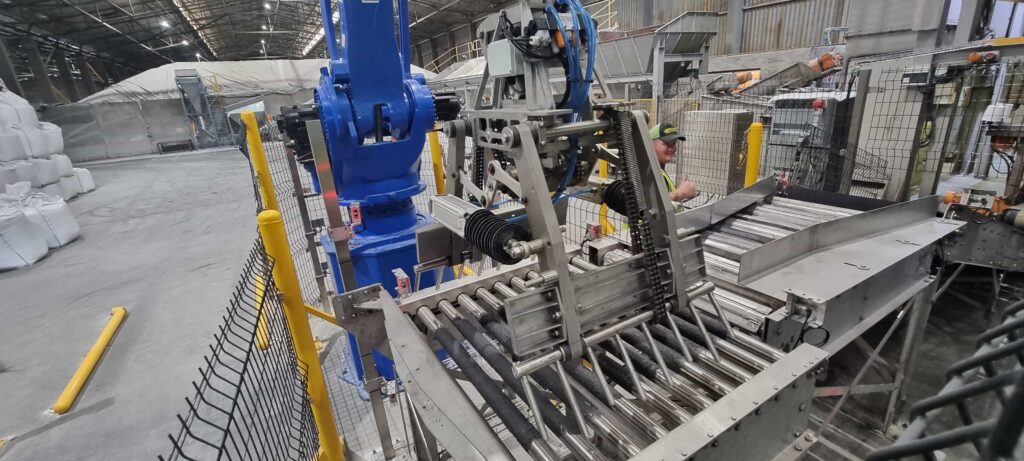
This is one of our two flagship grippers. It is a registered design and has been continuously improved, reducing breakdown stoppages to a minimum. Its unique feature is the ability to pack bags tightly against the inside walls of a bulk bag, ensuring stack stability during transportation. The gripper can be ordered as a stand-alone item or as part of a packing cell. It is offered in two primary size classes: 25 kg and 50 kg. One 50 kg version handles both 25- and 50 kg bags with a simple tool change. This is an extremely robust gripper, with the NPG25 weighing around 56 kg and the NPG50 typically weighing 96 kg.
2 - Heavy Duty Claw Gripper
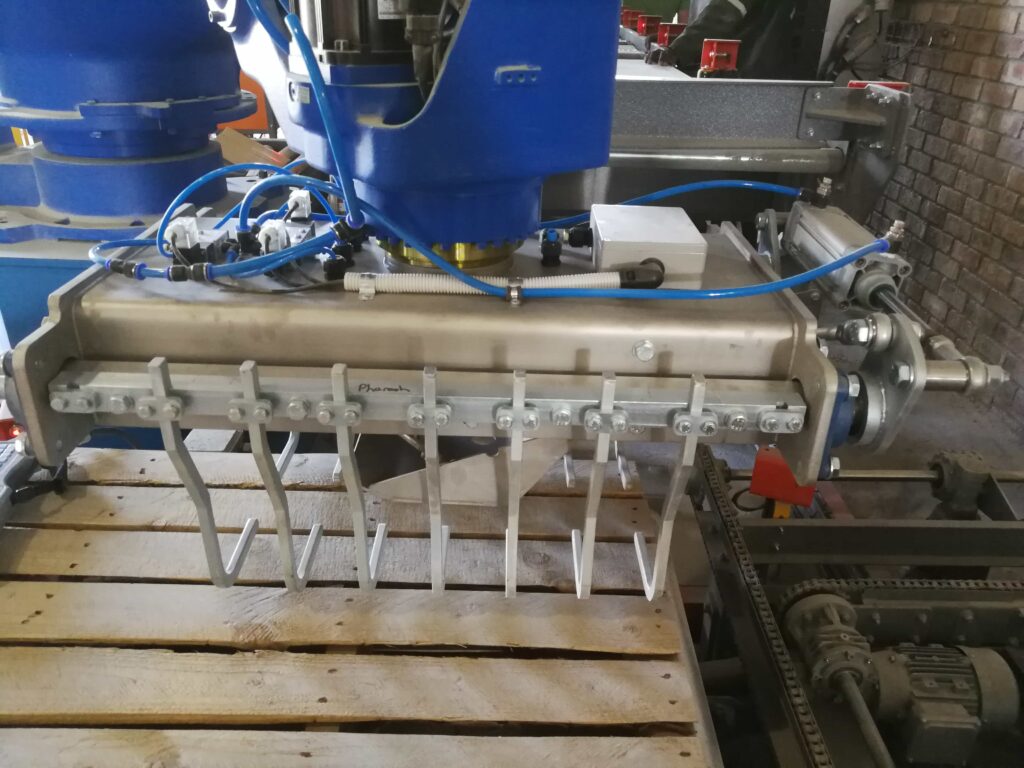
Our heavy-duty claw gripper is the second flagship gripper. As with the NPG, we prioritize robustness over lightness. The HDC25 and HDC50 weigh approximately 54kg and 99kg, respectively. Occasionally, a product may stop short after a power failure or twist due to snagging. The robot and gripper then collide with the product. What makes the HDC unique is that the teeth comb sets swap out as a unit, making crash repairs quick and minimizing production downtime. Damaged teeth can be repaired in the workshop or outside the packing cell. The HDC50 can pack the smallest to the largest bags with only a quick manual tooth comb set change.
3 - 5-In-1 Gripper
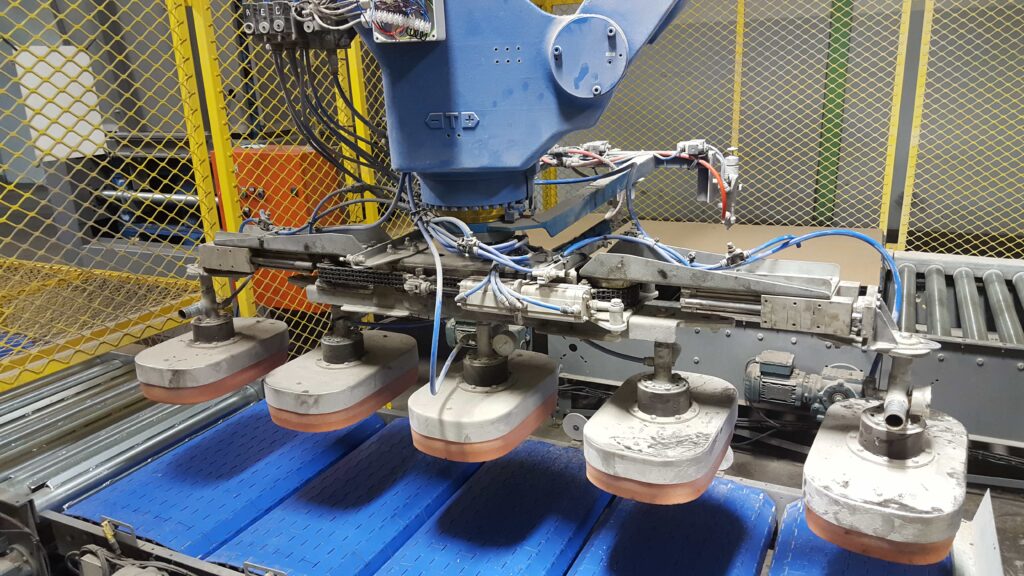
This gripper is purpose-specific. When packing rates are too high for a robot to pick and place one at a time, multiple picks in one go may be required. This led to the development of our five-in-one gripper. Designed to handle around 20 packages per minute, it surpasses the robot’s single-pick rate of approximately 16 packages per minute. The five-in-one gripper picks five products simultaneously and arranges them in a 3-2 layer pattern on a pallet, alternating layers to achieve stack interlocking. Due to the vacuum picking principle, which is sensitive to jerking motions, the base rate must be gentle.
4 - Box Gripper
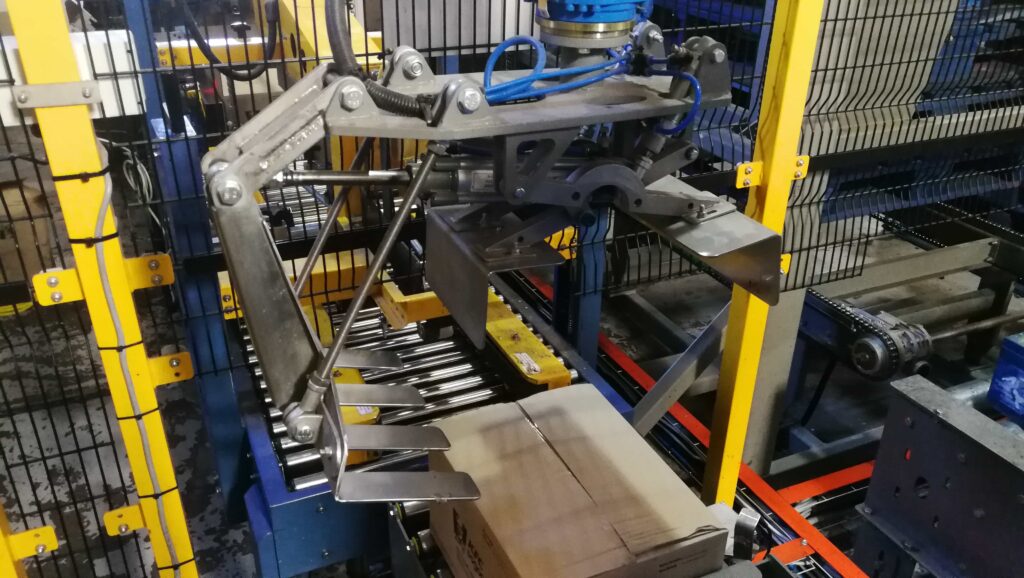
Traditional fork grippers are slow to release placed products and are bulky, requiring significant clearance to lift items, typically boxes. We developed our in-house box gripper to overcome these limitations. Its cantilever-based motion design eliminates the need for costly linear slides and bearings, reducing both cost and mass. The gripper is object-specific and requires a manual tool change if the picked product size varies significantly.
5 - Vacuum Gripper
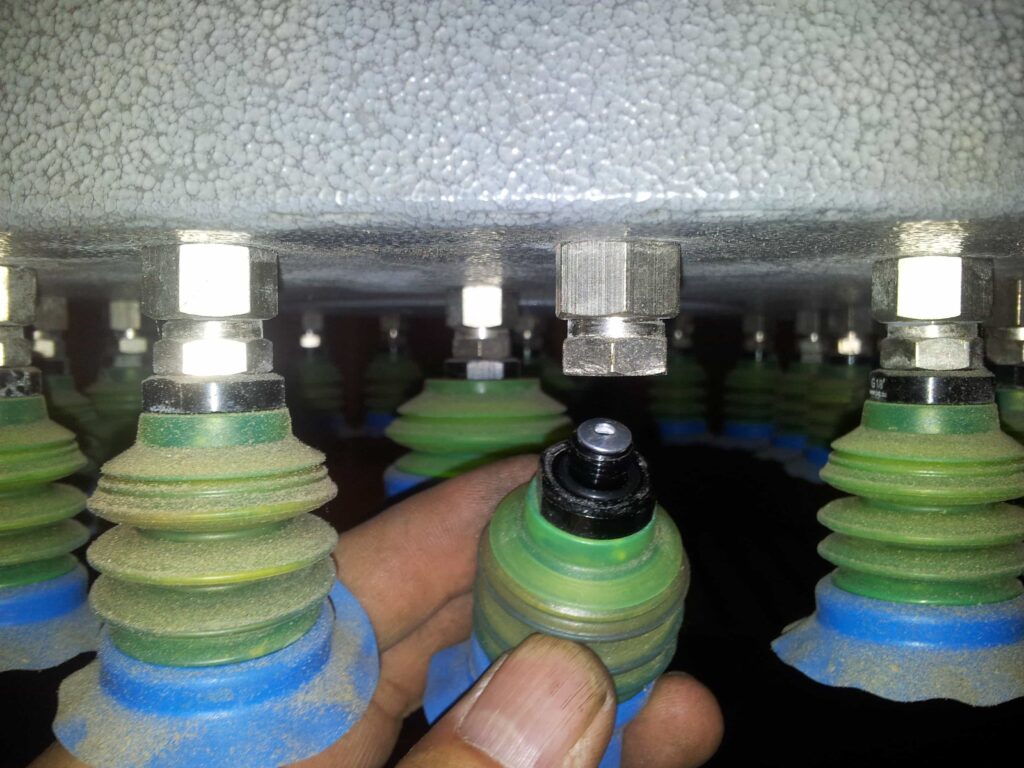
The 5-in-1 gripper uses a vacuum-based lifting mechanism, ideal for sacked products, plates, or other flat-topped items. Suction cup options offer almost infinite versatility, making this likely the most adaptable gripper type. Grippers are custom-made and task-specific. The main limitation of vacuum systems is the limited shear load resistance of the seal interface, requiring smooth motion paths and moderate acceleration, which may reduce ultimate packing rates. The type of vacuum generator required depends on potential seal leakage. We offer high-flow medium vacuum pressure and low-flow ultra-high vacuum pressure options.
6 - Fork Gripper
This gripper excels in accurate placement, minimizing product drop and maintaining stack stability, particularly for baled small products such as rice or sugar. Where pallet patterns and product characteristics allow, multiple simultaneous picks and individual placement are possible, increasing packing rates. Due to its unique construction, this gripper is often a high-cost option
7 - Hollow Block & Bailer Board Gripper
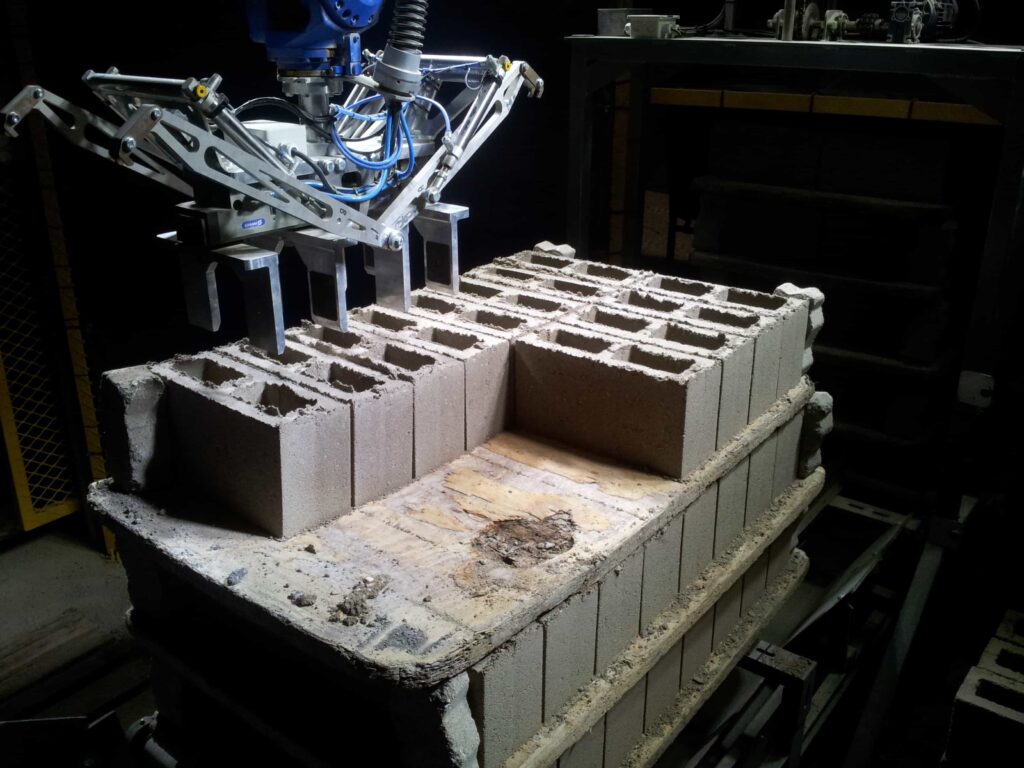
The cement hollow block market is challenging to automate and remains heavily labour-intensive. Across Africa, it also represents a major small-business opportunity, supporting thousands of jobs. However, the sector faces operational and structural challenges that make modernization difficult for many producers.
In 2013, we developed a specialised Hollow Block and Bailer Board Gripper specifically for automated cement block production. The system grips four complete blocks at a time (four groups of four per board) and stacks them on a standard 1.2 × 1 m pallet in a 3+2 alternating pattern—20 blocks per layer. It also lifts and positions the separating baler boards used during casting. The machine accepts full stacks of four boards and automatically indexes them through the process.
Single-board feeding would simplify the workflow, but many producers avoid destacking after drying—an industry-specific challenge we can address with an optional automation module. Although illicit activity eventually halted the original local project, the system clearly demonstrated its technical viability and consistent performance. The cement block industry is extreamly competitive and price sensitive. The advent of less popular robotic brands out of the East has enabled the cost of the robotic side to come down significantly. Further, the advanced vision sensors today further lower costs. This technology is more accessible than ever for operators ready to modernise their hollow block production lines.
8 - Speciality Tool Grippers (Built to Client Specification)
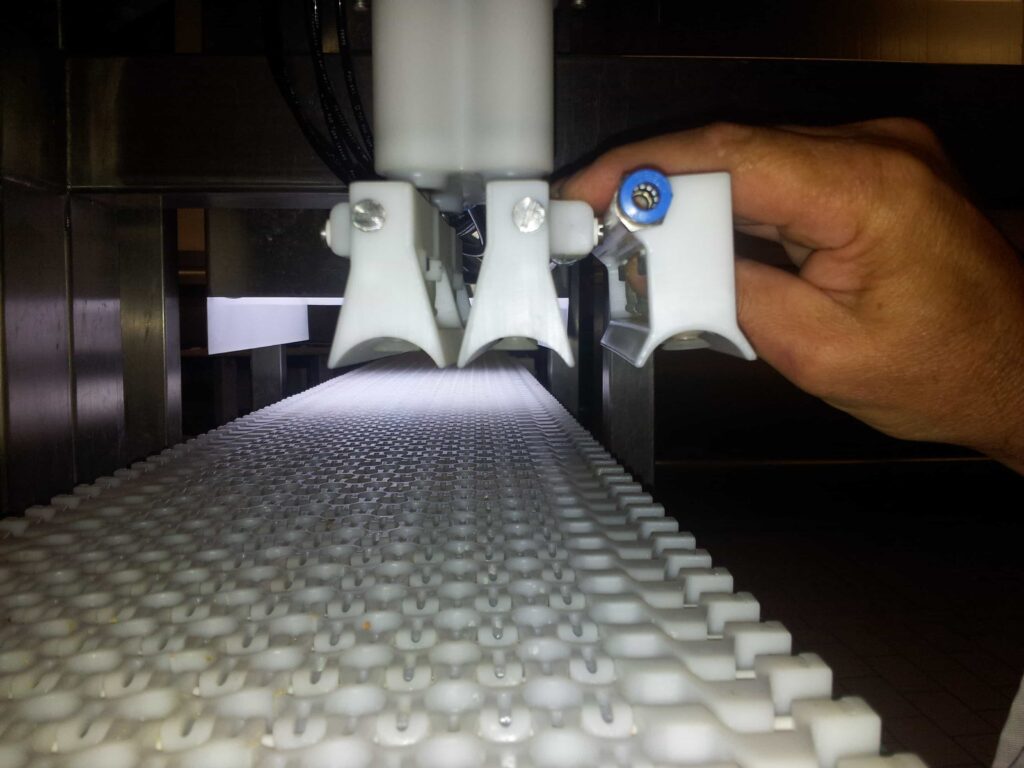
Occasionally, clients approach us with unique challenges, such as automating a cutting line with an angle grinder-mounted gripper, a polishing application, or other specialized tasks. We have the in-house expertise to evaluate your application, recommend a suitable solution, and design and develop the gripper.
9 - Speciality Magnetic Gripper (Scaffold Member Handling)
Metallic tubular and round bar products are ideally suited to magnetic pick-up. Strong rare-earth or electromagnets provide a secure alternative to other gripper types that require access underneath the product to engage it. Like other specialized grippers, these are custom-built to client-specific requirements.